Coway Airmega 150C Review: One Month in My Small Bedroom
Affiliate disclosure: I bought this air purifier with my own money. As an Amazon Associate I earn from qualifying purchases, at no additional cost to you. Amazon did not review or approve this article.
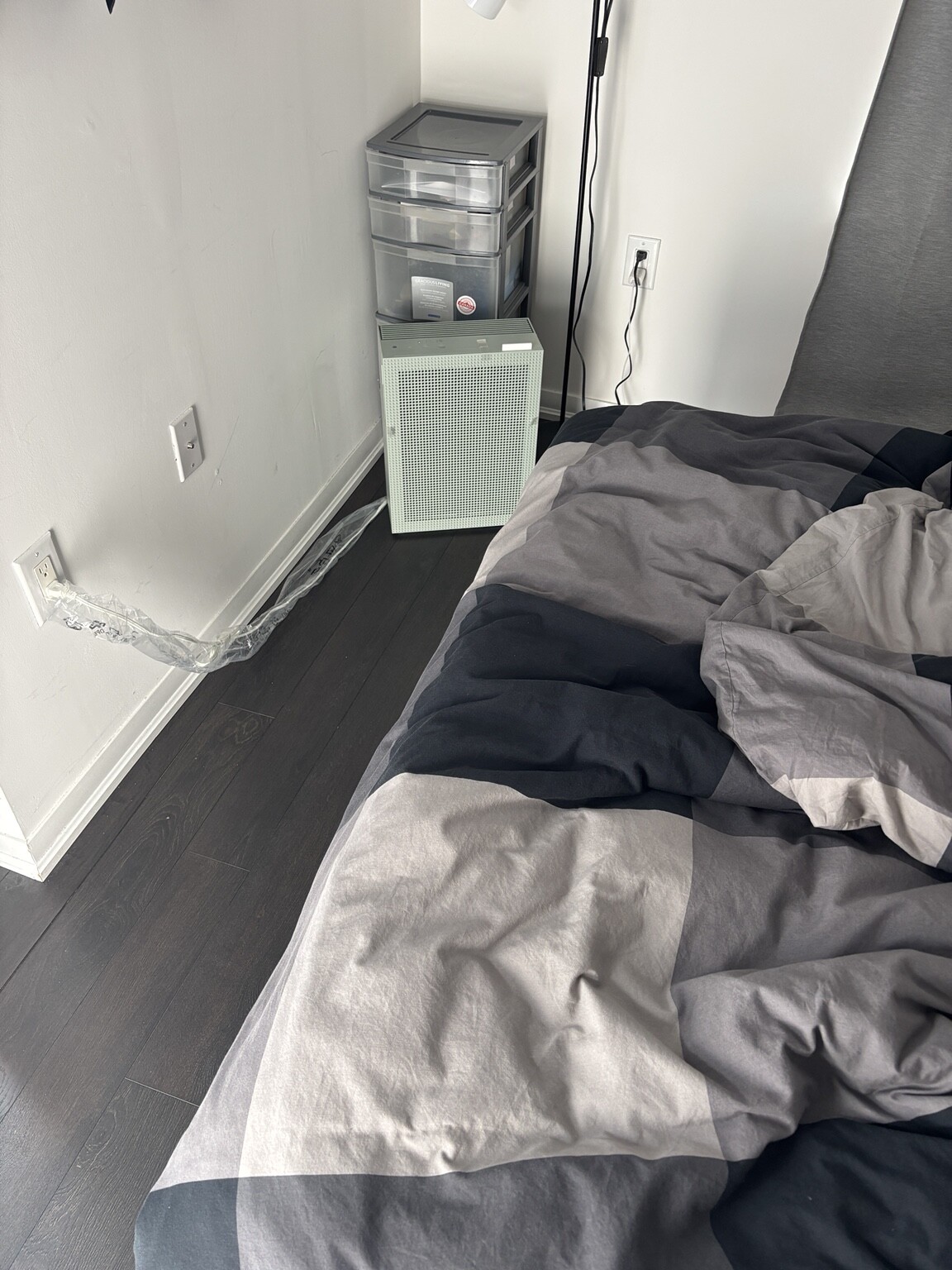
I bought the Coway Airmega 150C on August 18 and paid $278.43 CAD after tax. It now sits at the foot of my bed in a bedroom that measures about 108 square feet. I leave it on auto, sleep with it running and mostly forget that it is there.
That last point has become my favourite thing about it. The purifier is quiet enough to give the room a soft layer of white noise without interfering with my sleep. I have also felt less congested since I started using it. My congestion tends to get worse during the summer, so that change matters to me, although one month of personal experience cannot establish that the purifier caused it.
My early verdict is positive for a small bedroom. The Airmega 150C is simple, responsive and unusually easy to live with. Its deodorizing filter also appears better suited to everyday smells than serious smoke or volatile organic compounds.
If quiet operation and an unobtrusive design matter as much to you as raw cleaning speed, the balance may still make sense. You can check the current Canadian price on Amazon. Prices change, so I would compare it with other small-room purifiers before ordering.
Why I bought an air purifier
I live in a 500-square-foot condo, and I had been thinking more about air quality as smoke events and poor-air days became harder to ignore. I did not own another air purifier or a collection of air-quality gadgets. I wanted one machine for the room where I spend seven or eight hours every night.
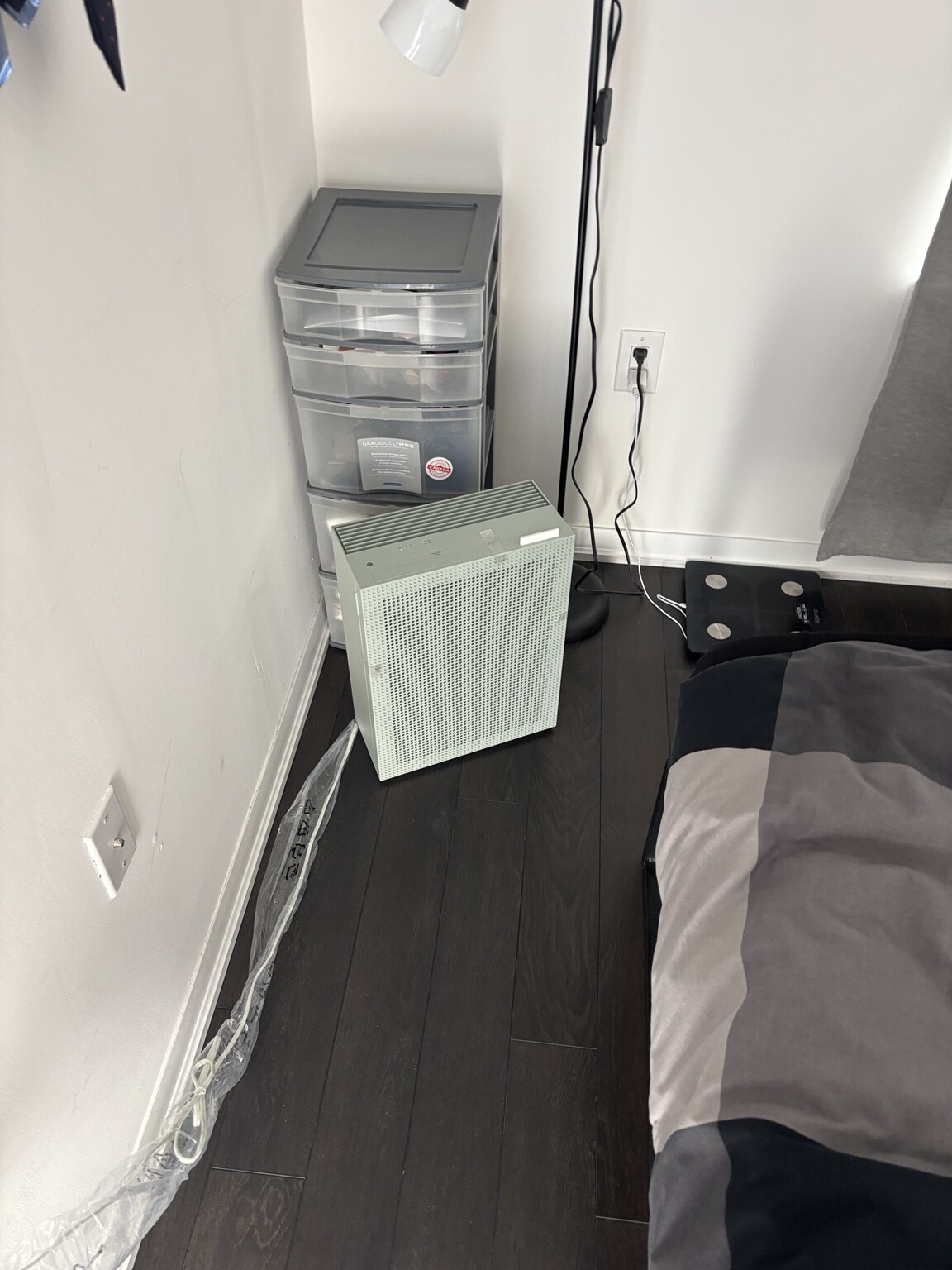
The Airmega 150C came up as an appropriate model for my room size. It also looked manageable in a small condo. Many purifiers resemble a large appliance or a piece of medical equipment. This one is a narrow sage-green rectangle with very little branding. It measures roughly 34 centimetres wide, 16.5 centimetres deep and 47 centimetres high, and weighs about 5.5 kilograms.
Those measurements sound ordinary on a product page. In a small room, they determine whether the machine becomes a permanent obstacle. Mine fits in the corner beside the bed and leaves enough walking space around it. It is also light enough to move without turning that into a project.
Is the Coway Airmega 150 powerful enough for a bedroom?
The room-size number on an air-purifier listing can be misleading without an air-change rate beside it. Amazon currently describes the Airmega 150 as covering up to 1,035 square feet. That large number reflects a much slower cleaning cycle than most people would want during smoke, pollen or dust exposure.
The recommended room size is roughly 237 square feet at 4.8 air changes per hour. It reports clean air delivery rates of 152.8 cubic feet per minute for smoke, 161.1 for dust and 219.8 for pollen. Clean air delivery rate, or CADR, estimates how much filtered air the purifier supplies each minute for different particle sizes.
My bedroom is about 8 feet 8 inches by 12 feet 6 inches, with a 9-foot ceiling. That gives it a volume of approximately 975 cubic feet. Using the smoke CADR as a conservative reference, the Airmega 150 could theoretically deliver about 9.4 equivalent air changes per hour at its rated test speed. Real performance depends on fan speed, placement, furniture and air leaking through the doorway. Auto mode frequently runs below maximum speed, so 9.4 is an upper estimate rather than my measured result.
The unit has ample rated capacity for my 108-square-foot bedroom. I would judge a 500-square-foot open condo differently. The U.S. Environmental Protection Agency recommends matching CADR to the room or area where the purifier will operate and accounting for ceilings higher than eight feet.
The sensor speed
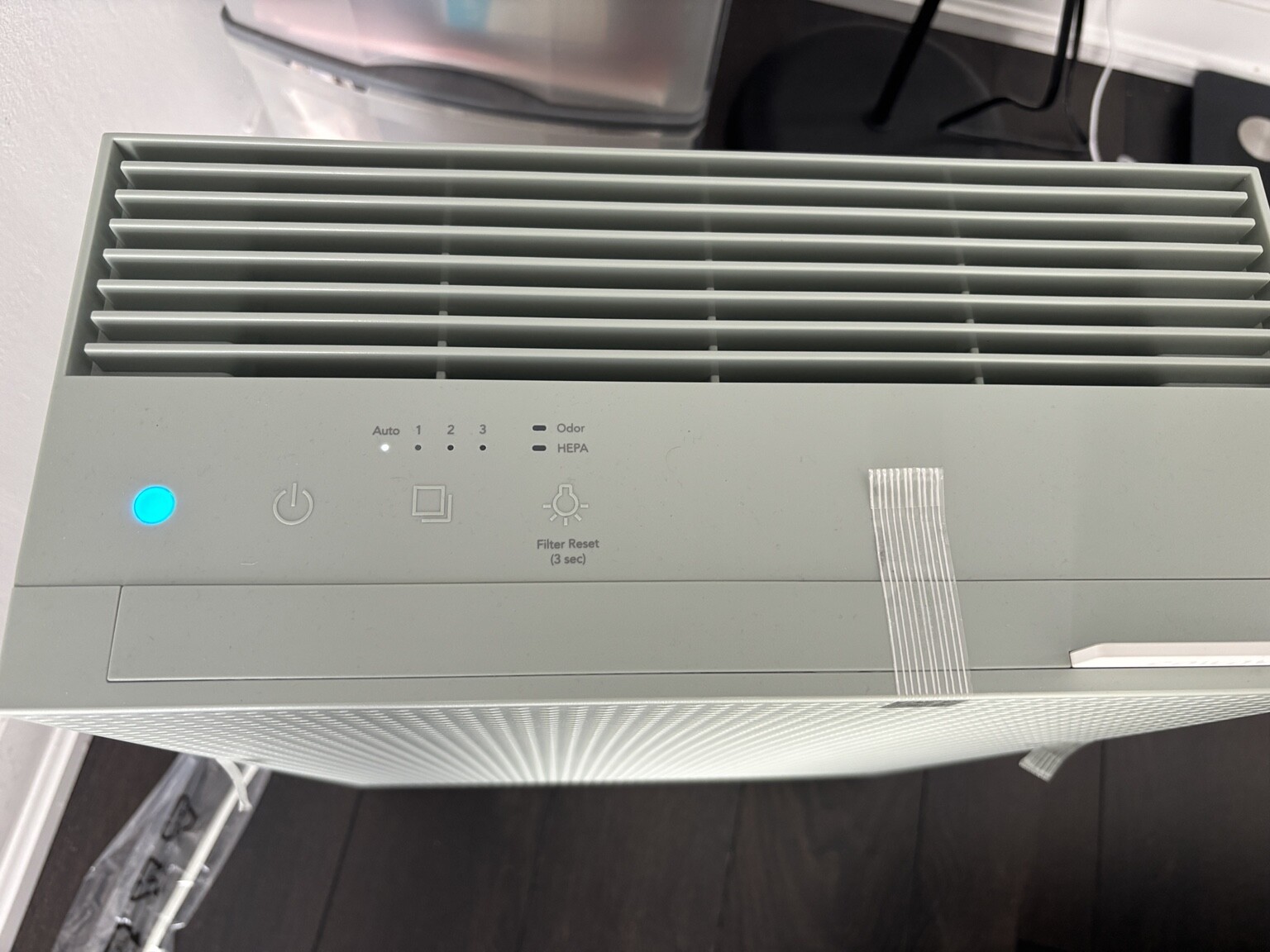
The clearest sign that the machine was doing something happened while I was organizing my bed. Moving the sheets sent visible dust into the air. Within about three seconds, the indicator changed and the fan sped up on its own.
That was more useful than watching the light remain blue all day. It showed that the sensor could recognize a sudden increase in airborne particles and that auto mode was willing to respond.
A colour-changing light is still a simplified signal. It does not tell me the room’s exact PM2.5 concentration, identify pollen or prove that every pollutant has been removed. The sensor controls the machine using the particles it can detect.
How quiet is the Coway Airmega 150 at night?
I run the purifier on auto rather than changing the speed each night. During normal operation, the sound is low and steady. It gives me a small amount of white noise that actually helps me fall asleep. I have not found it distracting, even though the unit sits only a few feet from the bed.
Independent measurements help put that experience into context. HouseFresh recorded 35.2 decibels on speed one, 39.5 decibels on speed two and 55.6 decibels on speed three from three feet away. The highest setting is clearly audible, while the lowest two explain why auto mode can disappear into a quiet bedroom when the air is already clean.
The fan can become noticeable after the sensor detects dust, but that has happened briefly in my room. Someone who is highly sensitive to changing fan noise may prefer a fixed low speed overnight. I like the automatic response enough to leave it alone.
I did have one minor annoyance with the control-panel lighting. The light-control icon appeared to illuminate unexpectedly a few times. Tapping the control turned the display off, and the issue has not returned. It was easy to solve, though I will watch for it over a longer period.
The removable pre-filter is genuinely convenient
The Airmega 150 uses three filtration stages: a washable pre-filter for larger debris, a deodorization layer and a HEPA filter for much smaller airborne particles. The pre-filter slides vertically out of the top using a small tab. You can remove it without opening the main filter compartment or moving the entire purifier.
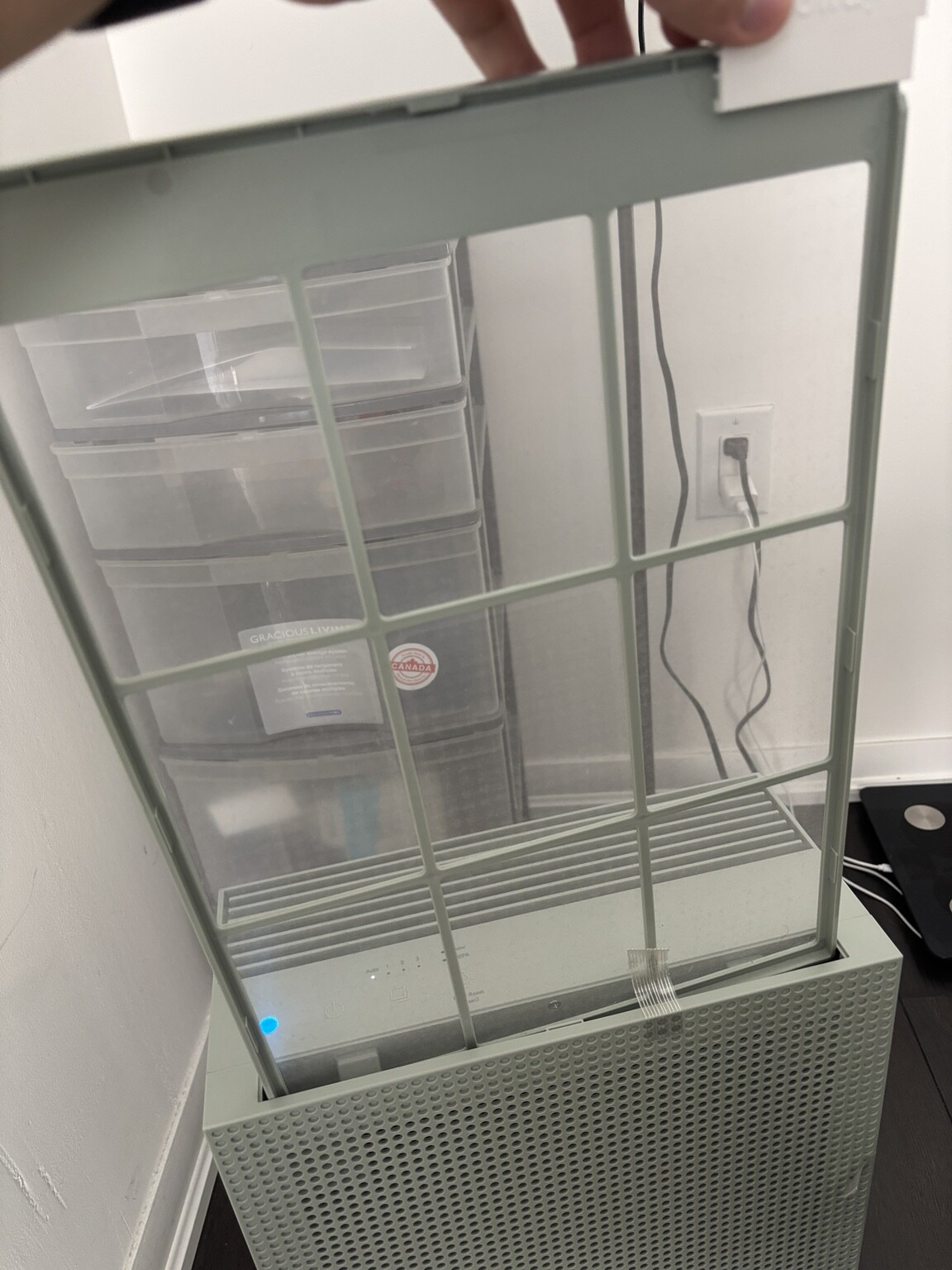
I have not washed mine yet because I have owned the purifier for less than a month. That limits what I can say about maintenance. I cannot yet verify how often the reminder appears, how well the main filter holds up or what replacement filters will cost me over a full year.
The design does make the first maintenance step unusually approachable. A washable pre-filter can capture hair and larger dust before they reach the more expensive filter. Keeping it clean should help airflow and reduce how quickly the inner filter becomes loaded.
Drawbacks
In a standardized 728-cubic-foot smoke test, HouseFresh measured 33 minutes for the Airmega 150 to remove the generated PM1, PM2.5 and PM10 pollution at maximum speed. The publication called that reasonable for the unit’s size. The Winix 5500-2 finished the same test 13 minutes sooner.
The Airmega’s narrow body, quiet low settings and sage finish have real value in my room. A buyer dealing with severe wildfire smoke or prioritizing the fastest particle removal may prefer a higher-output machine, even if it is larger or heavier.
Odour removal is another limitation worth understanding. HouseFresh found a thin carbon-impregnated fabric layer rather than a deep bed of activated-carbon pellets. The EPA notes that carbon filters work better for gases when they contain a substantial amount of adsorbent material. I have not tested this purifier against cooking fumes, cigarette smoke or persistent chemical odours, so I would not choose it primarily for those problems.
The Airmega 150C also lacks Wi-Fi, an app, a timer and detailed numerical air-quality readings. That simplicity suits me because I do not want another gadget demanding attention. If you want to review air-quality history from your phone or schedule the machine remotely, this model will feel sparse.
Does an air purifier explain feeling less congested?
I feel less congested at night since putting the purifier in my bedroom. I can report that experience honestly; I cannot isolate the cause. Seasonal congestion can change with pollen, humidity, weather, bedding and many other factors. The white noise may also improve my perception of sleep even when the air itself is not responsible.
According to the EPA, portable HEPA air cleaners can reduce airborne particles, and some studies have found improvements in certain allergy or asthma symptoms. Those improvements are often modest and do not appear for every person or every symptom. Filtration also works alongside source control and ventilation rather than replacing them.
For me, the useful result is straightforward: the room feels more comfortable, the sound helps me settle down and the purifier has not created a new inconvenience. I will need several more months, including another high-pollen period and my first filter replacement, before saying anything stronger.
Who I think should buy it
The Coway Airmega 150C makes the most sense for someone furnishing a bedroom, office or other small room who expects to run the purifier continuously. Its quiet lower speeds, responsive auto mode and compact shape make daily use easy. The sage-green finish is also a genuine advantage if a large white cylinder would bother you enough to hide it or turn it off.
After nearly a month, I am happy with the Airmega 150C in my bedroom. I notice its soft sound more than its physical presence, and even that has become part of falling asleep. The sensor responds when dust appears, the controls require almost no thought and the unit stays out of my way.
My recommendation comes with a time limit attached: this is an early ownership review. I still need to test maintenance, filter cost and reliability. If your room and priorities resemble mine, you can view the Airmega 150C on Amazon Canada and compare its current price with similarly sized models.
Sources and testing notes
- I purchased and photographed the Airmega 150C myself. My observations cover nearly one month of bedroom use on auto mode.
- HouseFresh’s Coway Airmega 150 review supplied the independent CADR, room-size, noise, electricity and smoke-test measurements, along with its criticisms of the carbon layer, casing and value.
- The EPA’s Guide to Air Cleaners in the Home supplied the guidance on sizing, CADR, filtration, carbon and the limits of health claims.
- The Canadian product listing was used to verify the current model identifier and listed product specifications. Coverage and price claims can change.