How to Start a Business When You Have No Idea Where to Start
Introduction
If you’re trying to figure out how to start a business, the best place to begin is not with a logo, a company name, or quitting your job.
There is a strange amount of pressure around starting a business.
Find the perfect idea. Build a brand. Make passive income. Quit your job. Scale it. Automate it. Do all of this before somebody else discovers the same opportunity.
I think this makes starting much harder than it needs to be.
If you have never built a business before, you do not need the perfect idea. You need a small experiment.
That experiment might be a simple website. It might be ten phone calls. It might be a $20 ad, a sample product, or an offer posted in a local Facebook group.
The question is not:
Will this become a million-dollar business?
You have almost no way of knowing that yet.
A better question is:
Can I get one real person to care about this?
And then, if the answer is yes:
Can I get another?
This is where I think a lot of business advice gets backwards. People spend weeks thinking about names, logos, business cards, incorporation, software, and websites before they have any evidence that somebody wants what they are selling.
You can do the opposite.
Start with the evidence.
Find something people already spend money on. Put together the simplest version you can. Show it to real people. See what happens.
If nobody cares, you’ve learned something without losing much.
If people do care, you have earned the right to spend a little more time and money on it.
This approach is much less exciting than announcing that you’ve “launched a startup.”
It is also much more useful.
And before getting into business ideas, advertising, validation, AI tools, directories, vending machines, or any of the other things we’ll cover, there is one boring but important place to start:
Your expectations.
Because starting a business is not automatically a ticket out of your job, and it certainly isn’t a shortcut to passive income.
1. Start with the right expectations
You probably don’t need to quit your job
Imagine you have a decent job and an idea for a small business.
Maybe it’s a service for local businesses. Maybe you’ve found a product you think people would buy. Maybe you’re a software developer and you’ve been thinking about building a small app.
The tempting version of the story goes like this:
Quit your job. Give yourself no choice. Go all in.
Sometimes that works.
It can also be a fairly expensive way to discover that your idea wasn’t very good.
There is usually no reason to make that decision at the beginning.
A job can actually be useful while you’re figuring things out. It pays the rent. It buys groceries. More importantly, it removes the pressure for your new business to start paying you immediately.
That gives you room to experiment.
Spend a few evenings working on it. Give it part of your Saturday. See if you can get a customer before you start worrying about becoming a full-time entrepreneur.
At this stage, you’re not trying to replace a $100,000 salary.
You’re trying to answer much smaller questions:
- Can I get someone to respond?
- Will somebody pay?
- Can I deliver what I promised?
- After costs, is there actually any money left?
- Would the customer buy again or recommend it?
Those answers are worth far more than another month spent thinking about the idea.
There may eventually come a point where your job becomes the thing holding the business back. If customers are coming in, the economics work, and you can see exactly what you’d do with another 30 hours each week, then the decision becomes more interesting.
But that’s a very different situation from quitting because you have an idea and want to force yourself to make it work.
I would put it this way:
Don’t quit your job so you can test a business. Test the business so you can decide whether quitting your job is worth it.
Being your own boss is a bit of a myth
Here’s another phrase I don’t particularly like:
“Be your own boss.”
It sounds nice.
No manager. No pointless meetings. No asking permission to take Friday afternoon off.
And yes, owning a business can give you more control over your life.
But you don’t exactly stop having bosses.
Your customers become your bosses.
If you hire employees, you have responsibilities to them. Suppliers expect to be paid. Partners expect you to do what you agreed to do. A client can still call you on Friday afternoon with a problem.
In some businesses, you may end up with far more people depending on you than you ever had at a normal job.
There are benefits, of course.
- You may get more control over what you work on.
- Your income may no longer have an obvious ceiling.
- You can build something that belongs to you.
But you might be giving up a few things as well:
- a predictable paycheck,
- fixed hours,
- clear responsibilities,
- paid vacation,
- and the underrated luxury of occasionally having somebody else make the decision.
Neither option is automatically better.
They’re just different.
And I think that is a much healthier way to approach entrepreneurship.
Don’t ask whether owning a business is better than having a job.
Ask:
Do I prefer the trade-offs that come with owning one?
You may not know yet.
That’s fine. Starting small is one way to find out.
Passive income usually comes later
Then we get to the phrase that seems to be attached to nearly every side hustle on the internet:
Passive income.
The basic idea is great. You build something once, and money continues coming in without you having to constantly work for it.
There are real examples of this.
But most small businesses don’t begin that way.
They begin with somebody doing a lot of work.
- You find customers.
- You answer emails.
- You make sales.
- You deliver the product.
- Something breaks.
- You fix it.
- A customer wants a refund.
- You deal with that too.
Not very passive.
And that’s okay.
Suppose you start a small cleaning business.
At first, you may be finding the customers and doing the cleaning yourself.
Then you get enough customers to hire somebody.
Then you build a process for scheduling.
Then payments become automatic.
Then somebody else handles customer service.
The business has slowly become less dependent on your hours.
The same thing can happen with software, a directory website, a rental business, a newsletter, or almost anything else.
But notice the order.
You didn’t start with passivity.
You started with something people were willing to pay for.
Then you made it more efficient.
This leads to a rule we’ll keep coming back to:
Don’t automate something that hasn’t worked yet.
First find demand.
Then make the business easier to run.
And if it eventually produces income without requiring much of your time?
Great.
Just don’t make that the requirement on day one.
Because the first goal of a business is not to be passive.
The first goal is to work.
2. How to Find a Business Idea
The first mistake people make when looking for a business idea is assuming it has to be original.
It doesn’t.
In fact, originality can sometimes make things harder.
If nobody has ever tried your idea before, that may mean you found something new.
It may also mean nobody wants it.
A much easier place to start is with something people are already buying.
Competition is not always bad news
Imagine you come up with an idea, search for it on Google, and find three companies already doing it.
A common reaction is:
“Never mind. Someone beat me to it.”
But there is another way to look at it.
Those companies may have just saved you a lot of work.
They have already shown that customers exist, people are willing to pay, and at least one version of the business can work.
That does not mean you should blindly copy another company.
It means you should stop treating competition as proof that an idea is dead.
Sometimes competition is the proof you were looking for.
If ten companies are selling bookkeeping services to dentists, you probably do not need to spend six months proving that dentists will pay for bookkeeping.
That part has already been tested.
Your question becomes much simpler:
Can I get a small piece of this market?
Study businesses that already work
Once you find a business that looks interesting, spend some time studying it before trying to improve it.
This sounds obvious, but it is easy to skip.
You might look at a competitor’s website for five minutes and immediately think:
I would change the pricing.
I would redesign this.
I would make checkout simpler.
Maybe those are good ideas.
But you might be looking at a decision that took the company ten years to arrive at.
Instead of asking:
“Why are they doing it this way?”
ask:
“Why did they end up doing it this way?”
Start with the basics.
Look at:
- what they sell,
- who they sell it to,
- how they describe the offer,
- how they price it,
- what the main call to action is,
- what customers praise,
- and what customers complain about.
Then look backward.
The Wayback Machine can show you older versions of a company’s website.
Maybe they started with three pricing plans and eventually moved to one.
Maybe they used to charge a one-time fee and later switched to a subscription.
Maybe they originally targeted everyone and now focus on one specific type of customer.
Those changes can tell you a lot.
Businesses rarely change pricing, positioning, or products for no reason.
You are looking for clues about what they learned.
Don’t assume the competitor is stupid
Let’s say you find a company with pricing that looks unnecessarily complicated.
They charge:
- a setup fee,
- a monthly fee,
- a storage fee,
- and extra charges for certain services.
Your first thought might be:
I can beat them by making the pricing simple.
Maybe you can.
But first, find out why those fees exist.
Suppose you run a fulfillment warehouse and decide not to charge storage fees because you want simpler pricing.
That sounds great until a customer goes out of business and leaves thousands of products sitting in your warehouse.
Now you’re paying for space that nobody is paying you for.
What looked like an annoying fee may actually solve a real problem.
This happens all the time in business.
A strange policy might exist because someone already learned the painful lesson you are about to learn.
That doesn’t mean competitors are always right.
It just means you should understand the reason behind something before removing it.
There is a big difference between:
“This looks stupid.”
and:
“I understand why they do this, but I think I have a better solution.”
Copy the model, not the brand
There is an obvious line here.
You should not copy someone else’s:
- logo,
- brand name,
- website copy,
- proprietary designs,
- or intellectual property.
But copying a proven business model is completely different.
Restaurants copy restaurant models.
Gyms sell memberships.
Software companies charge monthly subscriptions.
Real estate agents work on commission.
Cleaning businesses charge by the hour or by the job.
You do not need to invent a new way of doing business every time you start something.
A useful rule is:
Start close to what already works. Change things once you understand why they work.
If you change everything on day one, you may accidentally remove one of the parts that made the business successful in the first place.
Start with:
This seems to work. Why?
Then move to:
What could I improve?
Know when to copy and when to experiment
Not every business problem needs a new solution.
Some problems have existed for decades.
- Hiring.
- Payroll.
- Pricing.
- Customer service.
- Inventory.
- Bookkeeping.
- Cash flow.
Thousands of companies have already dealt with these problems.
If you run into one of them, your first move probably should not be to reinvent everything.
Look at how experienced businesses handle it.
Talk to someone who understands it.
Read about what has worked before.
Then there are newer problems.
Maybe a company is trying to figure out how to use AI.
Maybe a new platform has changed how customers discover products.
Maybe a new technology has created a type of business that barely existed a few years ago.
There may not be a clear answer yet.
That is where experimentation becomes more useful.
A simple rule is:
If the problem is old, learn from people who already solved it.
If the problem is new, test different solutions.
Look for your unfair advantage
Once you have a few ideas, ask yourself:
Why might this be easier for me than for the average person?
That is your unfair advantage.
It does not have to be dramatic.
You do not need a huge audience or wealthy parents.
Maybe you are a nurse and understand a problem inside hospitals.
Maybe you work in construction and know what wastes time on job sites.
Maybe you speak two languages.
Maybe you know a lot of wedding planners.
Maybe you have spent five years working with software most people have never heard of.
Maybe you understand a specific customer because you are one of them.
For example, imagine two people want to build software for plumbers.
One has never spoken to a plumber.
The other has run a plumbing company for ten years.
They can both build the same software.
But the second person probably understands:
- what plumbers complain about,
- which problems actually cost them money,
- what software they already use,
- what they would pay to fix,
- and how they talk about those problems.
That is an advantage.
Try making a simple list.
Write down:
- industries you’ve worked in,
- hobbies you know well,
- communities you belong to,
- skills you’ve built,
- people you know,
- and problems you’ve dealt with yourself.
Then look for business ideas where those things overlap with something people already spend money on.
You are not trying to find the perfect business.
You are trying to improve your odds.
Be careful with ideas that look too obvious
Some business ideas look amazing from far away.
The problem seems obvious.
The market looks huge.
You immediately wonder why nobody has already solved it.
Then you start researching and discover something interesting:
People have tried.
Again and again.
And almost all of them disappeared.
That should get your attention.
Maybe customers agree the problem exists but do not care enough to pay for a solution.
Maybe there is already a free option that is good enough.
Maybe customers are expensive to acquire.
Maybe people use the product for three months and then leave.
Maybe there are legal, technical, or operational problems that are not obvious from the outside.
Take software for podcasters.
At first, it sounds attractive.
There are millions of podcasts. Surely there must be plenty of software opportunities.
But many new podcasts stop publishing after a short period.
That means a company selling tools to beginner podcasters may constantly lose customers.
The market looks good from the outside.
The economics can tell a different story.
So if an idea seems incredibly obvious, do one extra thing:
Search for people who already tried it.
Find old startups.
Find abandoned products.
Search Reddit.
Look at old reviews.
See if the same idea keeps appearing and disappearing.
Then ask:
Why didn’t those businesses work?
If you can answer that question clearly and still believe you have a better approach, the idea may be worth testing.
If you cannot answer it, keep digging.
Finding a business idea is less about waiting for inspiration and more about learning how to look at what is already around you.
Look for places where people already spend money.
Study businesses that have survived.
Pay attention to strange decisions that may exist for a reason.
Look for areas where you already have some small advantage.
And when an opportunity looks obvious but nobody seems able to make it work, find out what you might be missing.
Once you have an idea that still looks interesting, the next step matters much more:
Find out whether real customers actually care.
3. How to Validate a Business Idea Before Spending Serious Money
Once you have a business idea, the next step is not building the full business.
It is finding out whether anybody actually wants it.
This is one of the most important parts of learning how to start a business, because a good idea in your head can look very different once real customers see it.
You want to learn that as early and as cheaply as possible.
Before spending thousands of dollars on inventory, software, branding, or equipment, try to collect some evidence.
What does it mean to validate a business idea?
Validation simply means getting evidence that real people care about what you are offering.
The important word there is evidence.
Your friend saying:
“That’s a cool idea.”
is not very strong evidence.
Neither is your mom saying she would buy it.
People are usually nice when you ask what they think.
Their actions tell you much more.
Better signs of interest include someone:
- asking how much it costs,
- joining a waiting list,
- requesting a quote,
- booking a call,
- asking when it will be available,
- giving you their email or phone number,
- placing an order,
- or paying you.
The closer you get to somebody actually spending money, the stronger the signal becomes.
Ten people clicking an ad is interesting.
Ten people asking for the price is more interesting.
Ten people paying you is much more interesting.
Start with the easiest test you can run
A common mistake is making the first test too complicated.
Suppose you want to start a new product company.
You might think you need to:
- find a manufacturer,
- order inventory,
- design the packaging,
- build an online store,
- register a company,
- and spend thousands of dollars on advertising.
That is a lot of work just to find out whether people care.
Try to find a smaller test.
Depending on the business, that could mean:
- creating a simple landing page,
- posting the offer in a relevant local community,
- running a small ad campaign,
- calling potential customers directly,
- showing people a prototype,
- offering the service manually before building software for it,
- or making a small batch of the product and seeing who buys it.
The goal is not to make the test perfect.
The goal is to get information back from the market.
This is why I prefer:
Test → Learn → Improve → Invest
instead of:
Build → Polish → Launch → Hope
Test one variable at a time
Once you start testing, be careful not to change everything at once.
Imagine you want to launch a new fitness product.
You are deciding between two versions:
- a powder,
- or a gummy.
You could create a simple image and description for each version and show them to the same type of customer.
Keep as much as possible the same:
- the audience,
- the location,
- the basic offer,
- the advertising budget,
- and the amount of time the test runs.
Then change one important thing:
the product format.
Now you can compare the response.
Maybe the powder gets 1,000 views and five inquiries.
The gummy gets 1,000 views and 30 inquiries.
That does not prove the gummy will become a successful business.
But it is a useful piece of information.
You now know which version probably deserves the next test.
Keep a simple testing spreadsheet
You do not need complicated analytics software for this.
A basic spreadsheet is enough.
| Test | Views | Clicks | Messages | Leads or Sales |
|---|---|---|---|---|
| Version A | 1,000 | 70 | 8 | 1 |
| Version B | 1,000 | 120 | 24 | 5 |
You can track:
- different prices,
- different images,
- different headlines,
- different customer groups,
- different product formats,
- and different offers.
This turns vague opinions into something you can compare.
Instead of saying:
“I think customers would prefer this.”
you can say:
“We tested both versions, and this one received three times as many inquiries.”
That is a much better place to make decisions from.
Talk to real customers
Online data is useful, but sometimes the fastest way to learn is simply talking to people.
This is especially useful if you sell something people can try.
Imagine you make a new type of cookie.
You send some to friends and ask:
“Do you like them?”
Most of your friends are probably going to say yes.
Now imagine giving the same cookie to strangers at a local market.
You can watch what happens.
Do they finish it?
Do they ask what is in it?
Do they ask where they can buy more?
Do they immediately ask for the price?
Or do they smile, say:
“That’s pretty good.”
and walk away?
Those are very different reactions.
This is why it helps to pay attention to what people do, not only what they tell you.
Look for customers pulling the business forward
Most new businesses require some pushing.
You have to advertise.
You have to explain the offer.
You have to follow up.
That is normal.
But every once in a while, you find something where the response feels different.
People start asking:
- “When can I buy this?”
- “Can you do this for my company?”
- “Do you have any more available?”
- “Can you send this to my friend?”
- “Can I order another one?”
Customers start referring other customers.
More orders arrive than you expected.
You start struggling to keep up.
That is a very good problem to have.
Think of it like pushing a heavy rock up a hill.
In many businesses, you spend most of your time pushing.
But occasionally you find an idea where it feels like the rock starts rolling downhill and you are trying to keep up with it.
That is what strong demand can feel like.
It does not mean the business is guaranteed to succeed.
You still need good pricing, operations, margins, and customer service.
But it is a strong signal that the market wants more of what you are offering.
Try to get to a sale as quickly as possible
If possible, your validation process should eventually lead to one question:
Will someone actually pay for this?
A thousand likes can feel impressive.
A hundred people joining a waiting list can look promising.
Twenty people asking questions can be useful.
But a paying customer gives you a different kind of information.
Someone has decided that your solution is worth more to them than the money you are asking for.
Even one sale can teach you a lot.
Where did that customer come from?
Why did they choose you?
What problem were they trying to solve?
What almost stopped them from buying?
Would they buy again?
Those answers help you build the next version of the business.
Don’t confuse a failed test with a failed business
There is one important warning here.
One bad test does not automatically mean the idea is bad.
Maybe you showed it to the wrong audience.
Maybe the price was wrong.
Maybe the ad was confusing.
Maybe people liked the product but did not understand the offer.
The point of testing is not to run one experiment and immediately declare:
“Success.”
or:
“Failure.”
The point is to collect enough information to decide what to test next.
If nobody responds after several reasonable attempts, that is useful information.
Stop.
Change the offer.
Try another customer.
Or move on to a different idea.
You have not failed.
You spent a small amount of time or money to avoid spending a much larger amount on something the market did not want.
That is exactly what validation is supposed to do.
The goal is not to prove that your idea is brilliant.
The goal is to find out what is true.
Start with a cheap test.
Watch what people do.
Track the results.
Try to get to a real sale.
Then let the evidence tell you whether the business deserves more of your time and money.
4. What Businesses Can You Actually Start Cheaply?
At this point, the obvious question is:
What kind of business can I actually start without much money?
The answer depends less on the exact amount of money you have and more on what the business requires upfront.
Some businesses need inventory, equipment, or a physical location.
Others mainly require time, outreach, and a few software tools.
If you are starting small, I would generally look for businesses where you can get your first customer before spending much money.
Businesses you can start with less than $500
AI implementation for small businesses
One of the more interesting opportunities right now is helping ordinary businesses use AI tools they do not have the time or interest to learn themselves.
You are not inventing a new AI model.
You are taking tools that already exist and using them to solve a practical problem.
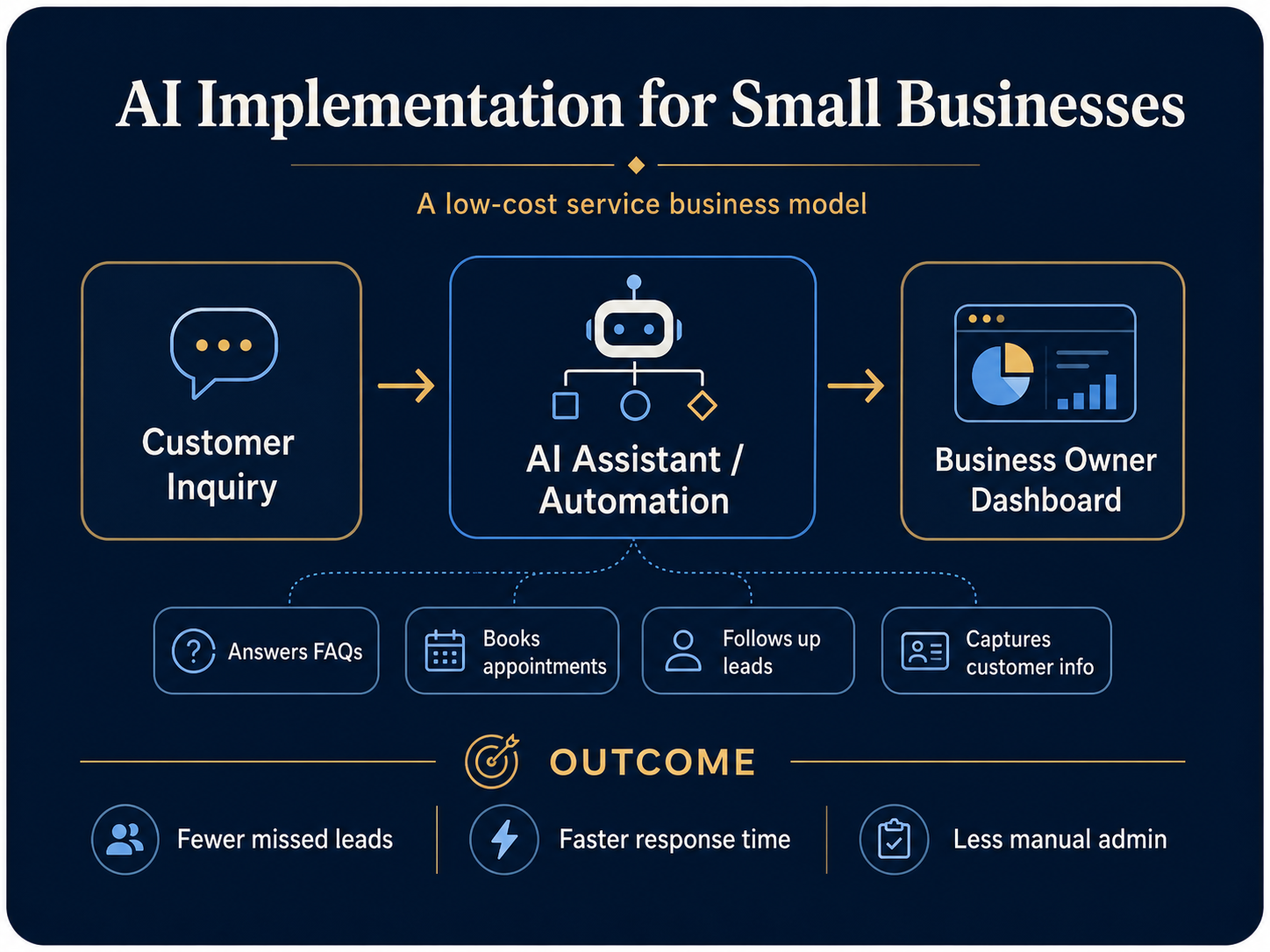
For example, a local service company might struggle with:
- missed phone calls,
- slow lead follow-up,
- appointment booking,
- answering repetitive customer questions,
- or keeping track of new inquiries.
You could build a simple system that helps with one of those problems and charge for the setup.
The important thing is to avoid selling:
“AI transformation.”
Most small business owners do not care about the technical details.
They care about outcomes.
A much clearer offer would be:
“I can help you respond to customers after hours so you lose fewer leads.”
That is easier to understand and easier to sell.
Drop servicing
Drop servicing is similar to subcontracting.
You find the customer and manage the sale, while another business or contractor performs the actual work.
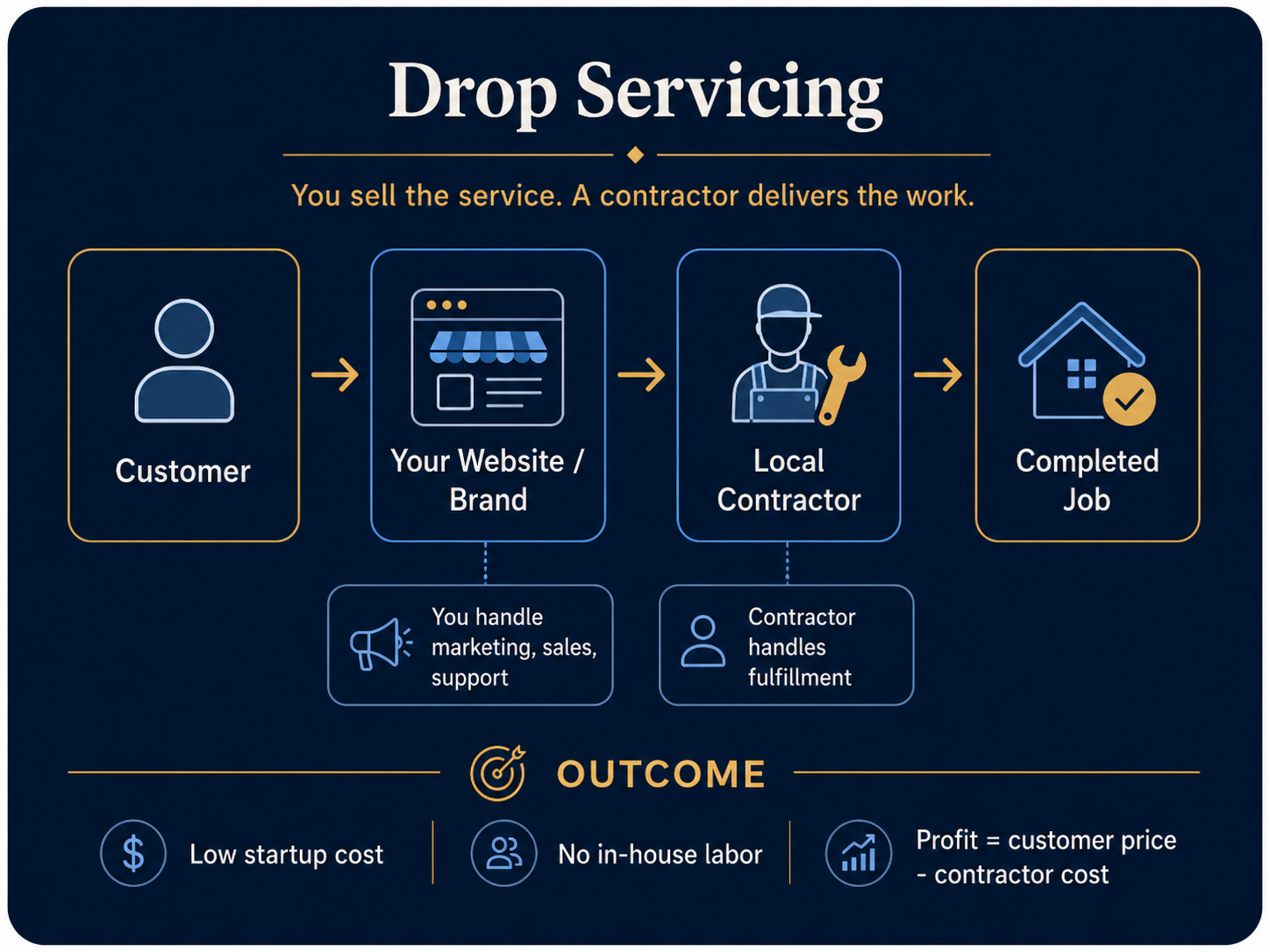
Imagine you create a simple website offering a local home service.
A customer finds you, requests the service, and pays you.
You then hire a qualified local contractor to complete the job.
Your role is mainly:
- marketing,
- sales,
- booking,
- customer service,
- and coordinating the work.
The contractor handles fulfillment.
This can work because many good tradespeople are much better at performing the service than they are at marketing it online.
But you still need to treat it like a real business.
Make sure the contractor is properly qualified, understand local rules, be clear with customers about what you are selling, and remember that you are still responsible for the customer experience.
Niche directory websites
A directory is simply a website that organizes useful information around one topic.
Think:
- dog-friendly patios in Toronto,
- wedding venues in a specific region,
- specialty food suppliers,
- local sports facilities,
- or businesses offering a very specific service.
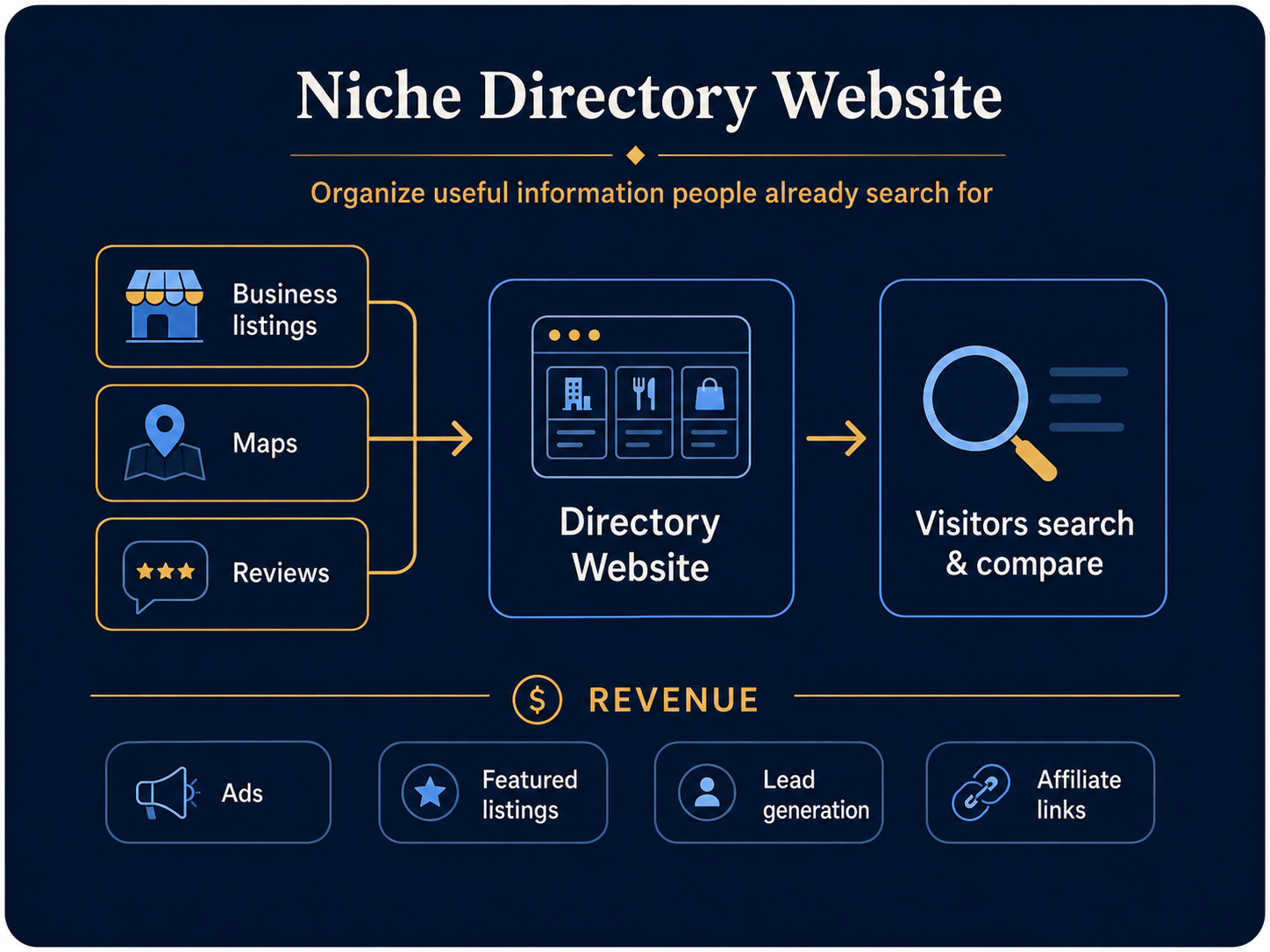
The idea is to pick a search where the existing results are scattered or difficult to use, then organize the information better.
You can monetize a directory later through:
- display advertising,
- featured listings,
- sponsorships,
- lead generation,
- or affiliate links.
The advantage is that a basic directory can be inexpensive to build.
The disadvantage is that traffic may take a long time to appear.
That means this is usually better treated as a low-cost experiment than something you expect to replace your salary immediately.
Vending machines
Vending machines are a good example of a simple business where the business model is easy to understand.
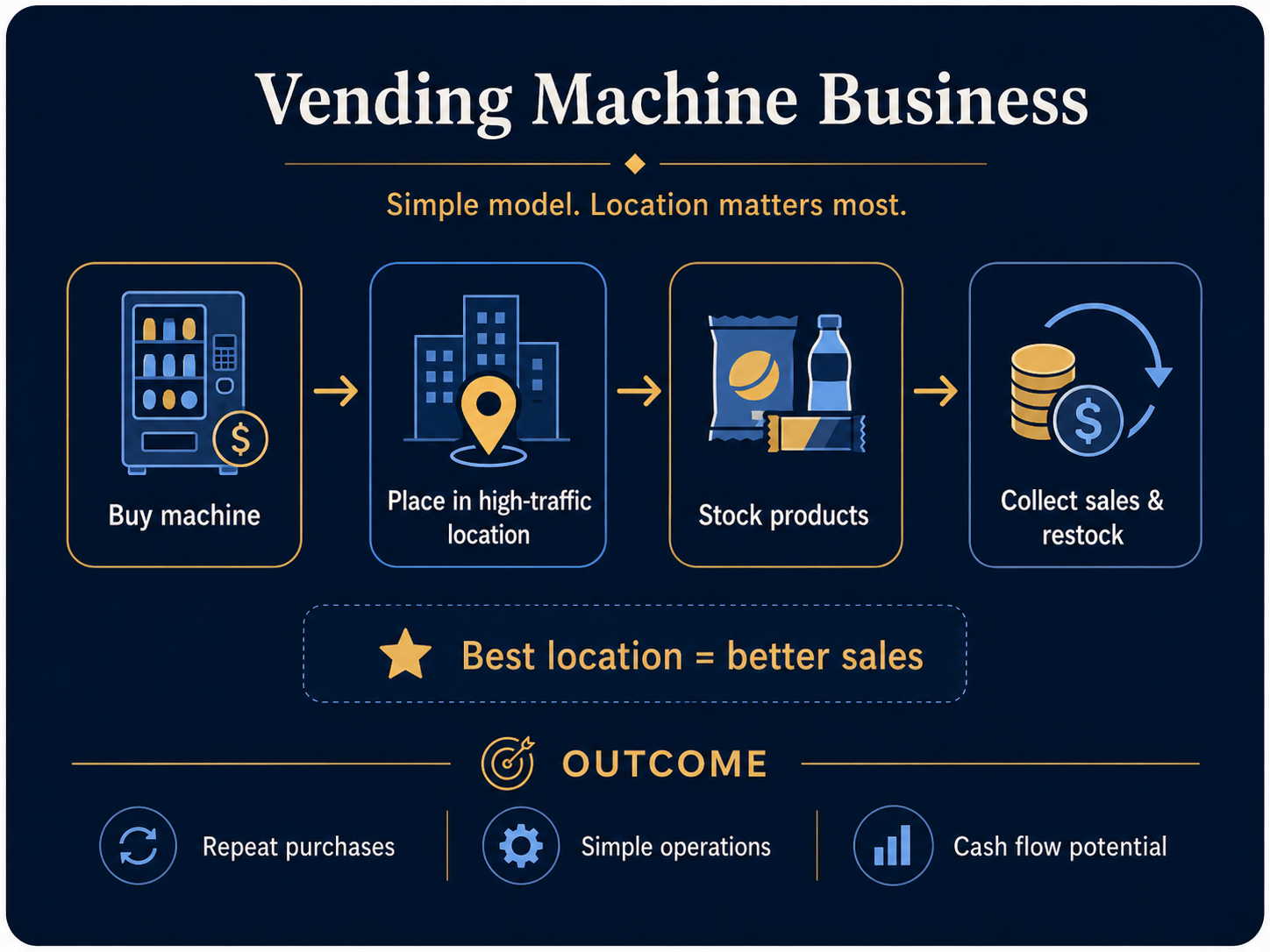
You:
- buy a machine,
- place it somewhere with regular foot traffic,
- stock it,
- and keep the difference between sales and your costs.
Used machines can sometimes be found cheaply enough to test the idea without making a huge investment.
The biggest variable is usually not the machine.
It is the location.
A great machine in a bad location may make very little money.
An ordinary machine in a busy apartment building, workplace, or waiting area may perform much better.
This brings us back to testing.
If one location performs poorly, do not immediately assume vending is a bad business.
The location itself may be the problem.
Businesses you can start with around $1,000
Wedding and event rentals
Weddings are full of items people need for one day and have little interest in owning.
That creates a natural rental market.
Examples include:
- wedding arches,
- photo walls,
- signage,
- decorative carts,
- small furniture pieces,
- and other reusable event displays.
The interesting part is not only the rental itself.
It is who you sell to.
Finding a new bride or groom every weekend means starting the sales process over and over.
A wedding planner, on the other hand, may work on dozens of weddings.
One good relationship can therefore produce repeated bookings.
This is a useful business lesson beyond weddings:
Whenever possible, sell to someone who can send you many customers instead of finding every customer one at a time.
A local email newsletter
Another relatively simple model is a local newsletter.
Pick a city or community and publish one useful email each week.
It could include:
- local events,
- new restaurants,
- business openings,
- weekend activities,
- local deals,
- or short summaries of local news.
Your first goal is building a useful local audience.
Once enough people are reading, you can sell sponsorships to businesses that want to reach that same audience.
A local restaurant probably does not need to advertise to the entire country.
It does care about reaching people who live ten minutes away.
That is what gives a local newsletter value.
The hardest part is usually building the audience.
But you can start with inexpensive newsletter software and test demand before building anything complicated.
What changes when you have around $5,000?
Having a little more capital gives you more options, but it also makes it easier to lose more money.
So I would not treat $5,000 as permission to skip validation.
If anything, the opposite is true.
Look for small assets or businesses that are poorly operated
One more advanced approach is looking for an existing small asset or business that already generates revenue but is poorly marketed or managed.
A small rental property, campground, storage operation, or other local asset may have problems such as:
- no proper website,
- poor online listings,
- low occupancy,
- outdated pricing,
- or an owner who no longer wants to manage it.
Instead of creating demand from nothing, you are trying to improve something that already exists.
In certain situations, a seller may even be willing to finance part of the purchase.
Seller financing simply means the seller allows you to pay some or all of the purchase price over time instead of receiving all of the money on day one.
This can reduce how much cash you need upfront.
But this is much more complicated than building a directory or offering a service.
You need to understand:
- contracts,
- financing terms,
- operating expenses,
- insurance,
- taxes,
- and the actual condition of what you are buying.
Professional legal and financial advice can be important here.
The broader idea is more useful than any one example:
Sometimes it is easier to improve an existing small business than to build an entirely new one from zero.
The amount of money matters less than the test
You could start a terrible business with $50,000.
You could also find a good business with $200.
The amount of money in your bank account does not tell you whether customers want what you are selling.
So regardless of whether your starting budget is $100, $500, or $5,000, the process should look roughly the same:
- Find a problem people already spend money solving.
- Study how existing businesses solve it.
- Create the cheapest reasonable version of the offer.
- Try to get a real customer.
- Spend more only when the evidence gives you a reason to.
Your first business does not need to be clever.
It needs to give you something to test.
5. When to Focus and When to Keep Testing
At some point, almost every new entrepreneur runs into the same problem:
Should I keep testing new ideas, or should I focus on the one I already have?
Both pieces of advice can be right.
The mistake is using them at the wrong time.
When you have very little evidence, testing different ideas can be useful. Once something clearly starts working, constantly jumping to something new can become a distraction.
Test broadly before you have strong evidence
In the beginning, you usually do not know which idea will work.
So there is nothing wrong with running several small experiments.
Maybe you test a local service business and get no response.
Then you try a niche directory and notice people are actually finding it through Google.
Then you offer an AI automation service and get three business owners asking for a demo.
Those tests are giving you information.
At this stage, being too focused can actually hurt you.
You might spend six months forcing one weak idea to work simply because somebody told you:
“Successful people never quit.”
Sometimes quitting is exactly what the evidence is telling you to do.
The key is keeping the experiments small enough that you can afford to be wrong.
Focus when the market gives you a reason
Eventually, one of your experiments may start behaving differently.
You get customers.
They come back.
People refer their friends.
Your ads make more money than they cost.
You have more work than you can comfortably handle.
That is when focus becomes much more important.
If one business is bringing in customers and another idea is still just sitting in a notebook, they should not receive equal attention.
A useful rule is:
Explore until you find a signal. Focus when the signal becomes strong.
This does not mean you can never start another business.
It means you should be careful about walking away from something that is already working because a newer idea feels more exciting.
Don’t confuse excitement with evidence
New ideas are fun.
You can imagine the website, the customers, the revenue, and how easy everything is going to be.
Then you actually start working on it.
You discover competitors.
You realize the software is harder to build than expected.
Customers do not respond immediately.
Suddenly the next idea looks much more interesting.
That cycle can repeat forever.
One simple way to control it is to keep an idea list instead of immediately acting on everything.
When a new idea comes to you, write it down.
Then wait.
If you completely forget about it a few days later, that probably tells you something.
If you are still researching it, noticing examples, and thinking about it two weeks later, it may deserve a proper test.
The point is not that two weeks is some perfect scientific rule.
It simply gives the initial excitement time to wear off.
Pay attention to why you are losing focus
Losing interest is not always a character flaw.
Sometimes it is useful information.
Maybe you keep avoiding sales because you hate the type of business you chose.
Maybe customers are not responding despite several good tests.
Maybe the margins are much worse than you expected.
Or maybe the business is actually working and you are simply bored because the exciting startup phase is over.
Those are very different situations.
Before quitting something, ask:
- Is the business getting customers?
- Is it profitable or moving toward profitability?
- Are customers coming back?
- Do I understand how to get more customers?
- Am I losing interest because the business is bad, or because something new looks more exciting?
If the numbers are bad, another experiment may make sense.
If the numbers are good, your boredom may not be a good reason to walk away.
You do not need to focus forever
Focus does not mean choosing one business for the rest of your life.
It means giving a promising opportunity enough attention to find out how far it can go.
Eventually, you may build systems around it.
You may hire someone to run the day-to-day work.
You may sell it.
Or you may simply decide you have taken it as far as you want to.
Then you can start experimenting again.
The goal is not maximum focus or maximum experimentation.
It is knowing which one your situation calls for.
When you have no evidence, explore. When customers start giving you evidence, pay attention.
6. When Should You Quit Your Job?
At some point, a side business may start taking enough of your time that you begin asking:
Should I quit my job and go full-time?
This is where the decision becomes more serious.
Testing a business on nights and weekends is one thing.
Giving up a steady paycheck is another.
There is no perfect number or formula for knowing when to make the jump. But there are a few signs that can make the decision much less reckless.
Do not quit just to force yourself to work harder
You will sometimes hear advice like:
“Burn the boats.”
The idea is that removing your backup plan will force you to make the business work.
There is some truth to this.
Pressure can make people focus.
If your business suddenly has to pay your rent, you may stop wasting time and start taking every customer more seriously.
But that does not mean quitting your job while the business is still only an idea.
There is a big difference between:
“I have an idea, so I am quitting.”
and:
“This business is already working, and my job is now limiting how much I can grow it.”
The second situation gives you something much more useful than motivation.
It gives you evidence.
Look for proof that the business already works
Before leaving a steady job, I would want to see some signs that the business is working consistently.
For example:
- customers are already paying you,
- you know where new customers are coming from,
- the business has positive margins,
- customers are returning or referring other people,
- your advertising is producing customers at a reasonable cost,
- and demand is becoming difficult to handle with your current schedule.
You do not need every one of these.
But the more evidence you have, the less you are guessing.
One of the strongest signs is when you already know exactly what you would do with more time.
Maybe you have leads sitting in your inbox because you cannot answer them during work.
Maybe customers are waiting two weeks because you only have Saturdays available.
Maybe your ads are profitable, but increasing the budget would create more orders than you can handle.
That is very different from thinking:
“If I had more time, I would probably figure something out.”
One is a bottleneck.
The other is a hope.
Know what going full-time is supposed to change
Before quitting, write down what you expect those extra hours to accomplish.
Maybe going full-time would allow you to:
- make 30 more sales calls each week,
- serve twice as many customers,
- launch another marketing channel,
- improve the product,
- hire and train someone,
- or build systems that are currently being handled manually.
More time does not automatically create more revenue.
A business with no demand does not suddenly become good because you spend 40 hours a week on it instead of 15.
But a business with more demand than you can handle may grow much faster once you can give it your full attention.
Build some financial runway first
Even a good business can have bad months.
Customers pay late.
Ads stop working.
Equipment breaks.
A large client leaves.
That is why having some savings matters.
You do not want every business decision to be made under the pressure of:
“I need money by Friday.”
The amount of runway you need depends on your situation.
Someone with low expenses and no dependents can usually take more risk than someone supporting a family or carrying large monthly expenses.
Before leaving your job, understand:
- your monthly personal expenses,
- your monthly business expenses,
- how much cash you have saved,
- how predictable your revenue is,
- and what happens if sales drop for several months.
You cannot remove all risk.
The goal is simply to understand the risk you are taking.
Think about your way back
Leaving a job does not have to mean permanently closing the door behind you.
Ask yourself:
- Could I return to this industry if the business failed?
- Would my previous employer consider rehiring me?
- Are my skills still in demand?
- Could I freelance or consult if I needed temporary income?
Knowing you have options can make taking a calculated risk much easier.
Failure does not necessarily mean starting your career over from zero.
Set a target before emotion takes over
It can help to decide in advance what would make you comfortable leaving your job.
For example:
“I will consider quitting when the business has covered 75% of my salary for six months and I have enough savings to cover one year of expenses.”
Your target may be completely different.
The exact numbers are less important than deciding what success looks like before one unusually good month changes your thinking.
Business revenue rarely moves in a straight line.
One great month can be followed by a bad one.
Look for consistency, not one exciting spike.
Treat quitting as a scaling decision
I think this is the simplest way to look at the whole decision.
Do not quit your job because quitting feels like the next step in becoming an entrepreneur.
Treat your time like a business resource.
Right now, your employer is buying most of that resource in exchange for a salary.
If your business reaches a point where those hours are clearly worth more inside the business, then moving them may make sense.
But let the business prove that first.
Do not quit your job because you are excited about the business. Quit when the business gives you a practical reason to need your time.
7. Do You Need a Business Partner?
A lot of first-time founders assume they need a business partner.
Starting alone feels intimidating, so splitting the work with someone else seems like the obvious solution.
Sometimes it is.
But adding a partner also creates a completely new set of problems.
Before giving someone a large piece of your business, it helps to ask a simple question:
What problem does this person solve that I cannot reasonably solve myself?
Do not add a partner just because you are nervous
Starting something alone can feel uncomfortable.
There are decisions to make, customers to find, and skills you probably do not have yet.
That can make a partner feel like insurance.
But two inexperienced people do not automatically create one experienced founder.
Sometimes you simply create twice as many opinions.
A partner makes more sense when there is a clear gap.
For example:
- you can build the product, but you are weak at sales,
- you understand marketing, but your partner understands the industry,
- you are good at finding customers, but someone else is much better at operations,
- or one person brings a skill or network that would be difficult to replace.
That is a much stronger reason to partner than:
“We are friends and this sounds fun.”
Learn how you work before choosing someone else
One reason I like starting small projects alone is that you learn a surprising amount about yourself.
You find out which parts of business give you energy.
You also find out which parts you avoid until the last possible minute.
A simple way to think about this is to divide business work into three broad roles.
The starter
Starters like the beginning.
They enjoy:
- new ideas,
- launching products,
- early marketing,
- finding opportunities,
- and figuring out how to get the first customers.
They can be very good at taking something from zero to one.
The problem is that maintaining the same business for five years may feel painfully boring.
The maintainer
Maintainers usually enjoy improving things that already exist.
They like:
- systems,
- processes,
- operations,
- small improvements,
- managing people,
- and making a business run more smoothly.
Give them a messy business with customers and they may turn it into a much better company.
The finisher
Finishers tend to be good at getting things across the line.
They may be especially good at:
- negotiating deals,
- building relationships,
- making introductions,
- raising money,
- hiring key people,
- or selling a business.
These are not strict personality types.
You may be good at two of them, or your strengths may change over time.
The useful part is simply knowing where you are strongest.
Once you know that, choosing a partner becomes easier.
Instead of looking for someone exactly like you, you can look for someone who fills the gaps.
Be careful with 50/50 partnerships
The easiest ownership split is:
50/50.
It feels fair.
Two founders. Half each. Done.
The problem is that businesses rarely stay equal.
One person may eventually work twice as many hours.
One person may bring in most of the customers.
One may invest more money.
One may have twenty years of industry experience while the other is learning as they go.
Their personal lives may change too.
Someone has children.
Someone moves.
Someone gets another opportunity.
Someone simply loses interest.
None of this necessarily means the partnership was a mistake.
It just means:
Equal ownership does not guarantee equal contribution forever.
Do not decide ownership over lunch
It is surprisingly common for two people to discuss a business idea for an hour and immediately agree to split everything equally.
That is a major decision to make before either person knows what the other will actually be like to work with.
A better approach is to test the working relationship first.
You might agree to reach a specific milestone together.
For example:
- build the first version of the product,
- get the first ten customers,
- reach $10,000 in revenue,
- or complete a defined three-month project.
During that period, you learn things you could never discover over coffee.
Who actually shows up?
Who makes decisions?
Who handles pressure well?
Who follows through?
Who avoids difficult work?
Those answers are much more useful when discussing a long-term partnership.
Talk about the uncomfortable things early
A business partnership usually becomes difficult because of things nobody discussed at the beginning.
Before formalizing anything, talk about:
- who is responsible for what,
- how many hours each person is expected to work,
- how much money each person is investing,
- how salaries will work,
- how profits will be distributed,
- how major decisions will be made,
- what happens if one person wants to leave,
- what happens if one person stops contributing,
- and what happens if someone wants to sell the business.
These conversations can feel awkward.
They are much less awkward than having them after the business is worth $2 million.
Hours are not the only measure of value
One of the hardest things about partnerships is measuring contribution.
Imagine one founder works 60 hours a week.
The other works 15.
At first glance, the answer seems obvious.
But what if the second founder has twenty years of industry experience and makes one phone call that lands the company’s biggest customer?
How do you compare that with 60 hours of operational work?
There is no perfect formula.
Value can come from:
- time,
- money,
- skills,
- relationships,
- reputation,
- intellectual property,
- or the ability to execute.
This is another reason not to rush ownership decisions.
A partner is not your only option
Sometimes you do not need a co-founder at all.
You may simply need help.
Instead of giving away part of the company, you could:
- hire a freelancer,
- use a contractor,
- hire an employee,
- pay a salesperson commission,
- work with an advisor,
- or pay another company to handle a specific function.
If you need someone to design your website, you probably do not need to give them 25% of the company.
You need a web designer.
If you hate bookkeeping, you probably do not need a co-founder who likes spreadsheets.
You may just need an accountant.
Ownership is one of the most expensive forms of payment because you are giving away part of everything the business may become.
Treat it accordingly.
The best partner should make the business stronger without creating another weakness
A good partnership can be extremely valuable.
Two people with complementary skills can build something neither could easily build alone.
But the decision should be based on what the business actually needs.
Start by understanding your own strengths.
Identify the gaps.
Work together before making permanent decisions.
Talk about money, responsibilities, and exits while everyone still gets along.
And remember:
You do not need a business partner just because starting alone feels difficult. You need one when the right person makes the business meaningfully better.
8. How to Make a Business Less Dependent on You
If your business starts working, a new problem usually appears:
You become the bottleneck.
Every customer question comes to you.
You handle every sale.
You fix every problem.
If you stop working, the business stops moving.
This is normal in the beginning.
In fact, trying to avoid this stage too early is usually a mistake.
Before you automate, delegate, or hire people, you need to understand how the business actually works.
Do the work manually first
There is a temptation to build systems before you have customers.
You create automated emails.
You build dashboards.
You connect five different software tools.
You spend days trying to make the business run without you.
There is just one problem:
You still do not know if anybody wants it.
Early on, doing things manually can actually be useful.
If someone submits a request, answer it yourself.
If a customer needs onboarding, walk them through it.
If you are selling a service, deliver the first few jobs yourself if you reasonably can.
This is how you learn:
- what customers repeatedly ask,
- where they get confused,
- which parts take the most time,
- which tasks actually require skill,
- and which tasks are basically the same every time.
Those repeated tasks are what you eventually want to systemize.
Document anything you do repeatedly
Once you notice yourself doing the same thing again and again, write it down.
It does not need to be complicated.
A simple checklist is enough.
Suppose every new client requires you to:
- send a welcome email,
- collect their information,
- create their account,
- schedule an introductory call,
- and send an invoice.
That is a process.
Write down the steps.
Now someone else can potentially follow them.
And once you can describe a task clearly, you have three options:
Automate it, delegate it, or keep doing it yourself.
Automate the boring and predictable work
Automation works best when the task follows a predictable pattern.
Good candidates might include:
- appointment reminders,
- invoice notifications,
- basic lead follow-up,
- customer intake forms,
- simple reporting,
- frequently asked questions,
- and moving information between software tools.
This is also where AI can be useful.
A business might use an AI assistant to answer common questions, collect lead information, or respond to simple inquiries after hours.
But automation should solve an existing problem.
Do not add technology simply because it looks impressive.
If answering five customer emails manually takes ten minutes a week, you probably do not need a complicated AI system.
If answering those emails takes two hours every day, now you have something worth solving.
Delegate work that does not require you
Some work cannot be automated well.
But that does not mean you personally need to do it.
Look at the things filling your week and ask:
Does this task specifically require me?
Often, the answer is no.
Tasks you may eventually delegate include:
- customer support,
- scheduling,
- bookkeeping,
- order fulfillment,
- administration,
- content editing,
- and routine operations.
At first, that might mean hiring a freelancer for five hours a week.
Later, it might mean hiring a full-time employee.
The goal is not to build a large team.
The goal is to stop spending your most valuable hours on work somebody else can do just as well.
Eventually, you may need an operator
This becomes especially important if you are very good at starting businesses but not particularly interested in running them every day.
Some people enjoy:
- finding ideas,
- launching offers,
- getting the first customers,
- and figuring out the early marketing.
Once the business becomes stable, they lose interest.
That does not automatically mean the business should be shut down.
It may mean somebody else is better suited to run it.
A good operator tends to enjoy things like:
- managing people,
- fixing processes,
- watching costs,
- handling recurring problems,
- and making small improvements every week.
Those skills are very different from launching something from scratch.
A business can become much stronger when the right person is doing the right kind of work.
Give operators a reason to care about profit
If somebody is responsible for running the business, their incentives matter.
A simple salary may be enough for many roles.
But for someone responsible for the performance of an entire business, it can sometimes make sense to connect part of their compensation to results.
For example, an operator could receive:
- a base salary plus a performance bonus,
- a percentage of quarterly profit,
- or another clearly defined reward tied to business performance.
This gives them a reason to care about more than simply completing tasks.
They start thinking about:
- reducing unnecessary costs,
- keeping customers happy,
- increasing revenue,
- and improving margins.
You do not necessarily need to give away ownership of the business to create that incentive.
Profit sharing can sometimes be simpler because the person receives real cash when the business performs well instead of receiving equity that may never be worth anything.
Remove yourself one responsibility at a time
Turning an active business into a less active one usually does not happen overnight.
It happens gradually.
Maybe at the beginning you do everything.
Then bookkeeping goes to an accountant.
Customer support goes to someone part-time.
Scheduling gets automated.
Fulfillment gets handed to an employee.
Eventually, an operator handles most of the day-to-day decisions.
Your role changes from:
doing the work
to:
checking that the system is working.
That is much closer to what people usually mean when they talk about passive income.
Passive does not mean zero work
Even a well-run business usually needs some attention.
Employees leave.
Software breaks.
Customers change.
Competitors appear.
Costs increase.
A business that requires five hours of your time each month can still be an excellent business.
It does not have to require zero hours to be worthwhile.
A more useful goal is:
Build something that does not collapse whenever you stop working for a day.
The order matters
There is a simple sequence here:
- Do the work yourself.
- Find out what customers actually want.
- Notice what repeats.
- Document the process.
- Automate predictable tasks.
- Delegate the rest.
- Eventually put the right operator in charge.
Trying to skip directly to step seven usually causes problems.
You cannot effectively hand someone a business you do not understand yourself.
First make it work.
Then make it repeatable.
Then make it less dependent on you.
9. A Simple 30-Day Plan to Start Testing Your Business
By this point, you may have several ideas in your head.
That is useful, but ideas only become valuable when you start testing them.
So instead of spending the next six months planning, give yourself 30 days.
The goal is not to build a finished company.
The goal is to answer one question:
Is there enough evidence here to keep going?
Days 1–3: Pick three ideas
Start by writing down three business ideas you would realistically consider trying.
Do not worry about finding the perfect one.
For each idea, answer these questions:
- Who is the customer?
- What problem am I solving?
- Are people already paying to solve this problem?
- Who already offers something similar?
- Why might I have an advantage here?
Then compare the three.
You are looking for the idea with the best combination of:
- clear demand,
- low startup cost,
- easy access to potential customers,
- and some reason you understand the market.
Pick one.
The other two are not gone forever.
You are simply choosing which experiment to run first.
Days 4–7: Study the market
Before creating anything, find at least five businesses already serving the same type of customer.
Write down:
- what they sell,
- how much they charge,
- who they appear to target,
- how they describe the problem,
- where they seem to get customers,
- and what their reviews say.
Pay particular attention to complaints.
If customers repeatedly say:
“They never answer the phone.”
or:
“Booking is a nightmare.”
you may have found an opportunity.
But do not assume every complaint should become your business.
First understand whether customers care enough about the problem to pay for a better solution.
Week 2: Build the smallest possible test
Now create the simplest version of the offer that lets you get feedback.
Not the final version.
The smallest useful version.
If you are testing a service business, that might be:
- a one-page website,
- a simple booking form,
- a phone number,
- and a clear description of what you do.
If you are testing software, you might not need software yet.
You may be able to perform the service manually for the first few customers.
If you are testing a physical product, make a sample or a very small batch instead of ordering hundreds of units.
Your goal for this week is simple:
Put the idea in front of real potential customers.
Try to get your first customer
This is where a lot of people hesitate.
Building the website feels productive.
Choosing a logo feels productive.
Watching another business video feels productive.
Asking someone to pay feels uncomfortable.
But that is the test.
Depending on the business, you might:
- email local businesses,
- call potential customers,
- run a small ad,
- post in a relevant community,
- attend a local event,
- or contact people directly.
You do not need hundreds of customers.
Try to get one.
One customer teaches you more than weeks of guessing.
Week 3: Talk to customers and prospects
Whether people buy or not, try to understand why.
Ask questions like:
- How are you solving this problem today?
- What is annoying about the current solution?
- How much does this problem cost you?
- What made you interested in my offer?
- What almost stopped you from buying?
- What would make this more useful?
Avoid trying to convince people that your idea is good.
Listen instead.
You are trying to understand the market, not win an argument.
Sometimes the customer will describe a better business idea than the one you started with.
Track what actually happens
Keep a simple spreadsheet during the month.
You can track:
- people contacted,
- responses,
- calls booked,
- quotes sent,
- sales,
- revenue,
- expenses,
- and common customer feedback.
This does not need to become complicated.
You simply want enough information to avoid relying on your memory or emotions.
A business can feel like it is going terribly because three people rejected you today.
Then you look at the spreadsheet and realize that 15% of the people you contacted became customers.
That is useful information.
Week 4: Make a decision
After a month, sit down and review what happened.
There are really only three reasonable outcomes.
Option 1: Stop
Maybe nobody cared.
Maybe customers liked the idea but would not pay enough to make it worthwhile.
Maybe you discovered that you hate the work.
That is fine.
You spent one month answering a question instead of spending two years wondering about it.
Option 2: Run another test
Maybe the results were mixed.
A few people were interested, but the offer was unclear.
Maybe one customer group responded and another did not.
Maybe the price was wrong.
In that case, change one important variable and test again.
You do not need to restart from zero.
Use what you learned.
Option 3: Double down
Maybe people paid.
Maybe they referred others.
Maybe you already have more demand than you expected.
That is when it makes sense to invest more.
Improve the website.
Spend more on the marketing channel that worked.
Build the proper version of the product.
Improve your systems.
But notice the order.
You are spending more because customers gave you a reason to spend more.
Your first 30 days should produce answers, not perfection
At the end of the month, you may not have a polished company.
That is not the point.
You should know much more than you did 30 days earlier.
You should understand:
- who your customer is,
- whether they care about the problem,
- what they are willing to pay,
- how difficult they are to reach,
- what competitors already offer,
- and whether you actually want to keep working on the business.
That is real progress.
You do not need to know whether an idea will succeed before you start. You need to make the first test cheap enough that being wrong is not a disaster.
Conclusion
Starting a business is not about finding one perfect idea and knowing in advance that it will work.
You probably will not know.
What you can do is make each step small enough that being wrong does not cost you much.
Start with something people already pay for.
Study businesses that already work.
Test the smallest version of your idea.
Talk to real customers.
Pay attention to what they do, not just what they say.
Then let the evidence decide what happens next.
If nobody cares, move on.
If there is some interest, test again.
If customers start buying, returning, and referring other people, that is when you have a reason to focus.
The same logic applies as the business grows.
Do the work manually before trying to automate everything.
Do not quit your job simply because you are excited.
Do not add a business partner just because starting alone feels uncomfortable.
And do not confuse passive income with income that requires no effort to build.
Most good businesses become simpler only after someone has done the difficult work of figuring out what customers want and how to deliver it reliably.
If you are trying to learn how to start a business, the most useful thing you can do is stop treating the first decision as permanent.
Your first idea can fail.
Your first offer can be wrong.
Your first ad can get no response.
That is fine.
The point is to learn cheaply enough that you can run another test.
You do not need to predict the winner. You need to stay in the game long enough to find one.
Pick one idea.
Give yourself 30 days.
Try to get one real customer.
Then decide what to do based on what actually happened.